Paulo Nimer Pjota: Na Boca do Sol II
François Ghebaly is proud to present Na Boca do Sol II, Paulo Nimer Pjota’s latest exhibition at the Los Angeles gallery.
Brazilian artist Paulo Nimer Pjota has long engaged painting as a recombinative practice, collapsing historical epochs and iconographic traditions within a signature transhistorical visual vocabulary. In his work, pre-Columbian pottery sits beside Flemish still life, Grecian amphorae overflow with mythic reference, and the pastoral landscapes of the Brazilian countryside bleed into arcane cartographies of dream and navigation. His newest exhibition, titled Na Boca do Sol II or “The Mouth of the Sun,” references a 1972 recording by Brazilian composer Arthur Verocai—a sun-drenched meditation on life in the provinces that, decades later, was heavily sampled by music producers in Los Angeles. Past sounds resurface in new contexts, mirroring the logic of Pjota’s paintings themselves, where histories are compressed and reanimated through symbols that transform across time and geographic place.
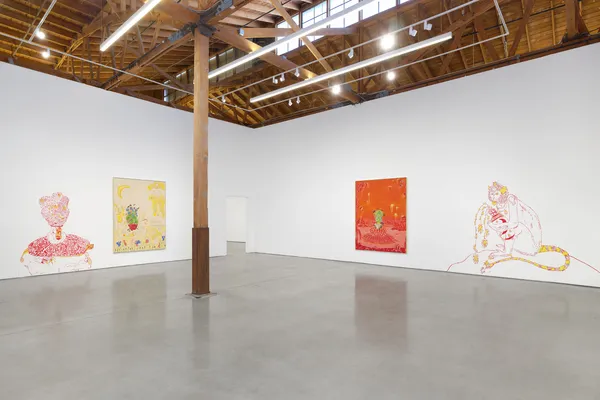
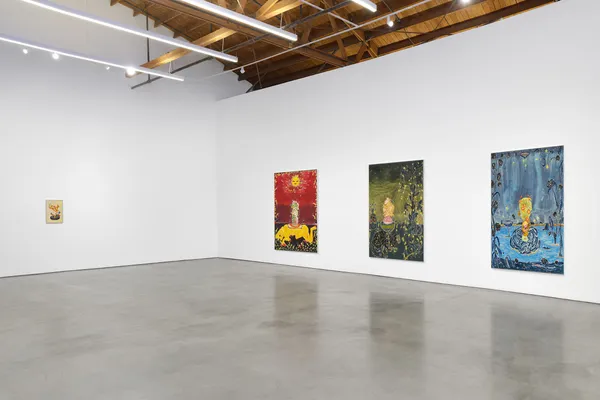
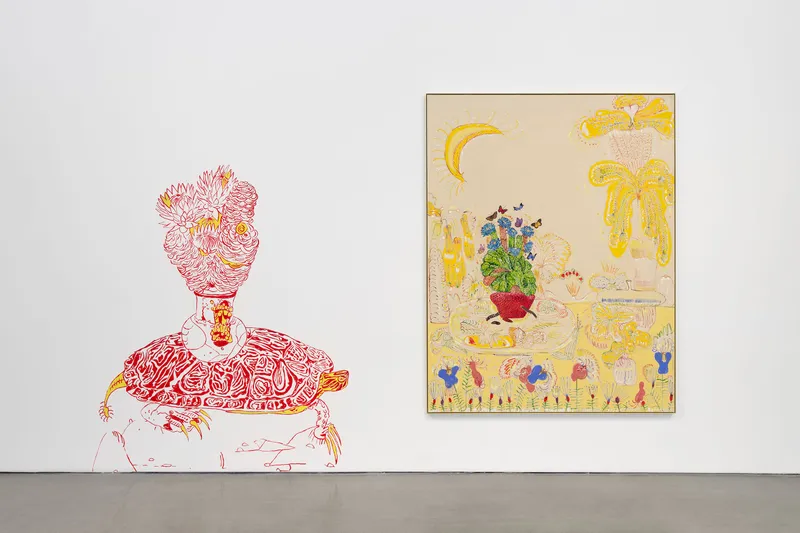
Na Boca do Sol II comprises twelve new paintings, installed atop large-scale mural drawings executed in red directly on the gallery walls. For Pjota, red is the color of fire and rebirth, and is associated with cyclicality and renewal. Here, the murals extend the dreamscapes of his canvases onto the gallery space itself. One work, Vitória-régia (2025), depicts a sacred red lake reminiscent of El Dorado legends, its center occupied by a reticulated ceramic vessel brimming with chrysanthemums and butterflies. Presented on a lily pad and a stand of red cacti, the flowers function as the composition’s central light source, resembling a kind of offering beneath falling stars.
Water appears throughout the exhibition as both symbol and environment, a conduit between founding mythologies across cultures and a medium of navigation and discovery. The powder-blue paintings A tartaruga e a raia (2025) and O jacaré e o peixe (2025) were the first works Pjota completed for the show. They imagine dusken water worlds populated by crocodiles, crabs, turtles, and strange pelagic fish, each bearing bouquets of illuminated cactus blossoms. Blue corresponds to the divine and the spirit in Pjota’s work, and often relates to twilight or intertidal zones where the terrestrial meets the cosmic. These paintings draw equally from medieval maritime maps whose illustrated monsters near the edges of the known world as from the domestic interiors of Pjota’s childhood. Vases, flowers, and tapestries recall his grandmother’s home in São José do Rio Preto, and were objects that served as his earliest painterly references and still retain their talismanic significance.
Pjota’s commitment to painting is a spiritual one, rooted in practices of repetition and meditation that relate to traditions such as Zen Buddhism and the writings of D.T. Suzuki. All eight of the large-scale paintings in the exhibition share the same linear dimensions and many are created simultaneously with echoing brushwork, reinforcing a kind of focused, meditative, even mystic physical practice in his work. Within this working process, the artist finds what he describes as “a gap or opening between long cycles of repetition” where new ideas and combinations emerge. In both subject matter and methodology, Pjota draws from Joseph Campbell’s concept of the monomyth and the hero’s journey: the cyclical return home after descent into the unknown. This narrative structure can be mapped across global storytelling and, in Pjota’s work, reflects Carl Jung’s theory of the collective unconscious. His paintings function as repositories for shared mythology, where symbols and origin stories accumulate without hierarchy. They collapse the distance between touchstones like Renaissance tempera fresco, memento mori iconography and still life traditions, and the rituals of domestic life. In Na Boca do Sol II, Pjota proposes that these cultural fragments are active forces in the present, endlessly renewed through the acts of art making and dreaming.